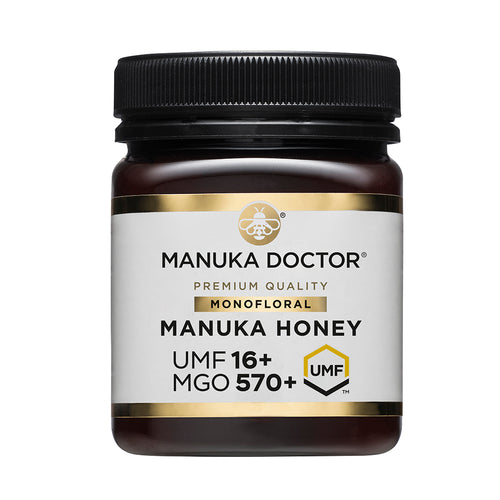
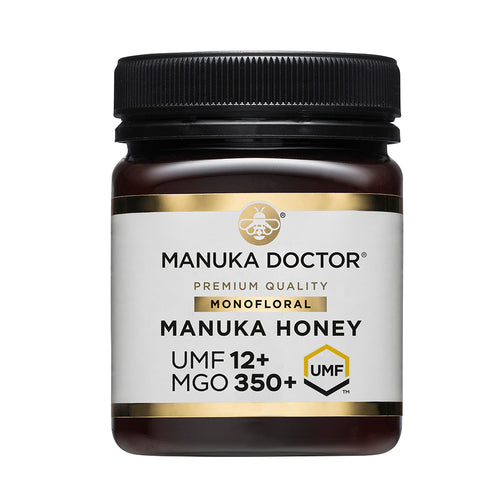
So what does UMF measure, and what does it guarantee?
To establish the UMF level of a Manuka honey, four things are checked.
1. The level of MGO in the honey. MGO (or methylglyoxal) is the substance that scientists generally concur gives manuka honey its special properties that other honey does not have. The higher the MGO level, the higher the UMF level will be and the stronger the anti-microbial benefits of the honey will be.
2. The presence of DHA in the honey. DHA (or dihydroxyacetone) is natural substance that is a precursor to MGO which is found in the nectar of Manuka flowers. DHA converts to MGO in the bee hive during the honey production process. Essentially, it’s impossible to have MGO in a Manuka honey without DHA. Therefore, in order to get a UMF rating, the honey must also show the presence of DHA to prove that the honey has been created in the correct way in a bee-hive and not chemically altered.
3. The level of Leptosperin. Leptosperin is another naturally-occurring chemical marker found only in the nectar of Manuka and some closely related species. It was discovered by Yoji Kato in Japan in 2012, and through UMFHA’s science programme, was found to be indicative of Manuka honey authenticity. i.e. if there is no Leptosperin in the Manuka honey, then the honey is not true manuka from New Zealand Manuka bushes. In order to secure a UMF rating, the level of Leptosperin in the honey must be more than 100 milligrams per kilogram.
4. The level of HMF (or Hydroxymethylfurfural). HMF concentrations increase under excessive heat and prolonged storage times. HMF is particularly relevant to Manuka honey as heat can be used to accelerate the conversion of DHA to MGO fraudulently, thus altering the chemical profile to make Manuka honey appear stronger and therefore more valuable. In order to protect customers, to secure a UMF rating, the HMF content after processing should not be more than 40 milligrams per kilogram.